I haven't been writing my blog for over a month. I have missed it also. My youngest black lab has been so ill, we have been in a draught and the diminished produce because of the cool spring and early summer, the hot hot rest of summer, no rain for way over a month, is now keeping me very busy harvesting and preserving the vegetables that made it through all this.
WE have also had a huge infestation of the yellow jacket wasps and the queen bee nest is hidden in the straw where my potatoes are planted. Difficult to walk in the garden without getting multiple stings. But my squash is big and beautiful and for a change I did get lots of green beans this year, one of my most favorite vegetables.
This gardening season has been a challenge and a joy all wrapped up in one. The draught has been the most difficult because even with regular watering the plants have become stressed and not as fruitful. I have noticed that where I have not had pests in my garden all summer, that with the draught and plants become stressed, the square vine bore bugs, tons of grasshoppers, the wasps and the tomato blight have just sored in the last 2-3 weeks.
We truly just need to practice the best gardening techniques and leave the rest to nature. Next year I say, there are some things I will do differently. Gardening is scientific, creative and intuitive and it is important to use all three skills and then let go and enjoy and learn.
So for now, I may not blog a lot till late winter next year. Have a great rest of the year. Maggie

Friday, September 13, 2013

Monday, August 12, 2013
FALL IS IN THE AIR ALREADY!
Cool spring, hot summer for a period of time and here it is almost the middle of August and harvest time. It feels like fall already. The weather is cool, the vegetables are harvesting and leaves are turning brown on some of the vegetables. Our weather is so unpredictable.
I miss the creative, planning, dreaming of the vegetables time of gardening. Though I do appreciate the entire process I particularly love creating what and where to plant my favorite mouth-watering vegetables. There is a little tiny bit of sadness creeping into my soul knowing that in about a month I will be doing garden clean-up and preparing for the winter months. For a short period of time there will not be an active "garden time". And then again right after the first of this next year, gardening begins again with evaluating last years vegetable gardens and designing the new; ordering seed catalogs and starting to plan the growing of the new seedlings. It is all a part of the process and experience of vegetable gardening. It is a renewable circle of creation!!! It is not a linear experience.
Don't forget to plant your garlic this fall!!!
I miss the creative, planning, dreaming of the vegetables time of gardening. Though I do appreciate the entire process I particularly love creating what and where to plant my favorite mouth-watering vegetables. There is a little tiny bit of sadness creeping into my soul knowing that in about a month I will be doing garden clean-up and preparing for the winter months. For a short period of time there will not be an active "garden time". And then again right after the first of this next year, gardening begins again with evaluating last years vegetable gardens and designing the new; ordering seed catalogs and starting to plan the growing of the new seedlings. It is all a part of the process and experience of vegetable gardening. It is a renewable circle of creation!!! It is not a linear experience.
Don't forget to plant your garlic this fall!!!
Tuesday, August 6, 2013
CONTINUING THE MID-SUMMER VEGETABLE GARDEN EVALUATION
CONTINUING ON WITH A MID-SUMMER GARDEN EVALUATION..........
In evaluating my garden, I believe it is important to factor in all the moisture we got this spring and early summer and the above normal high temperatures throughout July. So, I am going to be kind to myself as I continue the evaluation.
We covered the FAVA BEANS, CABBAGE and ZUCCHINI so lets talk about the hot and green peppers, and green beans. Last year the rabbits ate my green beans so this year I put rabbit fence around it's growing area and also planted two short rows on the north side of the raised gardens bed (climbing beans with a trellis). The rabbits have not eaten the beans this year. Lots of blossoms on both the bush and climbing beans, leaves look really healthy and large. One thing I would change is to put more space between the row of the bush green beans and the climbing beans so that there is more air flow...an important and key factor in good healthy plants and produce. So, my mouth is watering thinking that I will really get green beans this year as I love them in my diet. Just a note about green beans, fertilize the soil with compost initially and the beans usually do not need a lot of nitrogen because they produce nitrogen nodules for self-feeding at the base of their roots. If they receive too much nitrogen they end up with lots of green leaves and reduced green beans.


Pole beans at 96 degree F on 7/18
Update: rabbits got under the rabbit fence and ate a lot of my green bean blossoms. Nail it down well at the bottom of the fence and use blocks of wood to block any entry in any part....I hope. Found two beans which I ate. So, I did get some beans.
 My peppers took a long time to show much growth in height and also blossoms this year. Peppers are a warm weather plant and need 8-10 hours of full sun. It was so cool this early summer that I believe that is what caused such a slow growth initially...now they are a "cooken", getting tall with lots of blossoms and some ripe fruit on them. Will need to stake some of them today. They really don't mind being planted fairly close together...kind of a "community centered" plant :)!! And if planted close together, it helps to keep pests down. I planted some hot peppers but mostly the sweet peppers. A note: my organic gardening book states that all parts of the pepper plant are poisonous except for the fruit....first I have read this. Also if the temperature outside (F) rises above 95 degrees F, sprinkle plants with water in the afternoon to prevent blossom drop (The Gardeners A-Z Guide to Growing Organic Food). Peppers like to be fertilized upon planting and then side dressing with compost at blossom time and then 3 weeks later. If they have trouble fruiting, you can spray the leaves with a weak epsom salt mixture to promote fruiting. Be sure to keep them watered well. I would have to say that this is the best year I have had for growing peoppers.

In evaluating my garden, I believe it is important to factor in all the moisture we got this spring and early summer and the above normal high temperatures throughout July. So, I am going to be kind to myself as I continue the evaluation.
We covered the FAVA BEANS, CABBAGE and ZUCCHINI so lets talk about the hot and green peppers, and green beans. Last year the rabbits ate my green beans so this year I put rabbit fence around it's growing area and also planted two short rows on the north side of the raised gardens bed (climbing beans with a trellis). The rabbits have not eaten the beans this year. Lots of blossoms on both the bush and climbing beans, leaves look really healthy and large. One thing I would change is to put more space between the row of the bush green beans and the climbing beans so that there is more air flow...an important and key factor in good healthy plants and produce. So, my mouth is watering thinking that I will really get green beans this year as I love them in my diet. Just a note about green beans, fertilize the soil with compost initially and the beans usually do not need a lot of nitrogen because they produce nitrogen nodules for self-feeding at the base of their roots. If they receive too much nitrogen they end up with lots of green leaves and reduced green beans.


Pole beans at 96 degree F on 7/18
Update: rabbits got under the rabbit fence and ate a lot of my green bean blossoms. Nail it down well at the bottom of the fence and use blocks of wood to block any entry in any part....I hope. Found two beans which I ate. So, I did get some beans.
 My peppers took a long time to show much growth in height and also blossoms this year. Peppers are a warm weather plant and need 8-10 hours of full sun. It was so cool this early summer that I believe that is what caused such a slow growth initially...now they are a "cooken", getting tall with lots of blossoms and some ripe fruit on them. Will need to stake some of them today. They really don't mind being planted fairly close together...kind of a "community centered" plant :)!! And if planted close together, it helps to keep pests down. I planted some hot peppers but mostly the sweet peppers. A note: my organic gardening book states that all parts of the pepper plant are poisonous except for the fruit....first I have read this. Also if the temperature outside (F) rises above 95 degrees F, sprinkle plants with water in the afternoon to prevent blossom drop (The Gardeners A-Z Guide to Growing Organic Food). Peppers like to be fertilized upon planting and then side dressing with compost at blossom time and then 3 weeks later. If they have trouble fruiting, you can spray the leaves with a weak epsom salt mixture to promote fruiting. Be sure to keep them watered well. I would have to say that this is the best year I have had for growing peoppers.
Thursday, July 25, 2013
EVALUATION OF POTTING SOIL VERSUS HALF SOIL HALF COMPOST FOR CONTAINER VEGETABLES
Today I want to talk about healthy soil medium especially for container planting. I am the "soil girl" and have a great affinity to the science of soil and soil medium. I also believe in experimenting and allowing my creativity and intuition to guide me along with scientific information.
I have been researching soil medium for container vegetables especially. Almost all information suggests using potting soil as the soil medium, add a little Osmocote perhaps and you will have great results. So, I used the potting soil with the Osmocote for my cabbage and zucchini plants along with my tomatoes this year. Container vegetable success is not only related to a well draining, light, organic mixture but also to the type of roots: short, long, vertical, etc. Roots, I believe are key to success with container gardening...how deep to they grow; how long are they; do they expand down or horizontally,etc. I am finding that if roots are long such as with the zucchini, they grow poorly in containers. Tomatoes also have relatively long roots and so container gardening for the larger plants isn't the best choice.
So, here is what happened for me: the zucchini "puttered out" in containers and gave me one zucchini that grew to about six inches and stayed there for over a month. All other zucchini plants in containers died even with side-dressing with compost several times. We had a lot of rain this spring so these plants got the water they needed through rain or manual watering. My tomatoes are not growing the abundance of leaves that they usually do when in the ground and I still am getting the blight that I get every year with soil planting of tomatoes even with compost side-dressing. Time to evaluate if potting soil is appropriate for "heavy feeders" with some of the vegetables.
One of my conclusions is that there is not enough nutrition in the potting soil with 1/3 peat moss, 1/3 compost and 1/3 vermiculite which is recommended for container planting. Next year I am going back to my 1/2 soil and 1/2 compost with side dressing every two weeks as was done last few years. There is such a marked difference between my container vegetable plants this year and last year. Good to experiment but think I'll go back to a soil medium heavier on the nutrition and compost side.


I have been researching soil medium for container vegetables especially. Almost all information suggests using potting soil as the soil medium, add a little Osmocote perhaps and you will have great results. So, I used the potting soil with the Osmocote for my cabbage and zucchini plants along with my tomatoes this year. Container vegetable success is not only related to a well draining, light, organic mixture but also to the type of roots: short, long, vertical, etc. Roots, I believe are key to success with container gardening...how deep to they grow; how long are they; do they expand down or horizontally,etc. I am finding that if roots are long such as with the zucchini, they grow poorly in containers. Tomatoes also have relatively long roots and so container gardening for the larger plants isn't the best choice.
So, here is what happened for me: the zucchini "puttered out" in containers and gave me one zucchini that grew to about six inches and stayed there for over a month. All other zucchini plants in containers died even with side-dressing with compost several times. We had a lot of rain this spring so these plants got the water they needed through rain or manual watering. My tomatoes are not growing the abundance of leaves that they usually do when in the ground and I still am getting the blight that I get every year with soil planting of tomatoes even with compost side-dressing. Time to evaluate if potting soil is appropriate for "heavy feeders" with some of the vegetables.
One of my conclusions is that there is not enough nutrition in the potting soil with 1/3 peat moss, 1/3 compost and 1/3 vermiculite which is recommended for container planting. Next year I am going back to my 1/2 soil and 1/2 compost with side dressing every two weeks as was done last few years. There is such a marked difference between my container vegetable plants this year and last year. Good to experiment but think I'll go back to a soil medium heavier on the nutrition and compost side.

2012

2012

2012

2012


2013
Monday, July 22, 2013
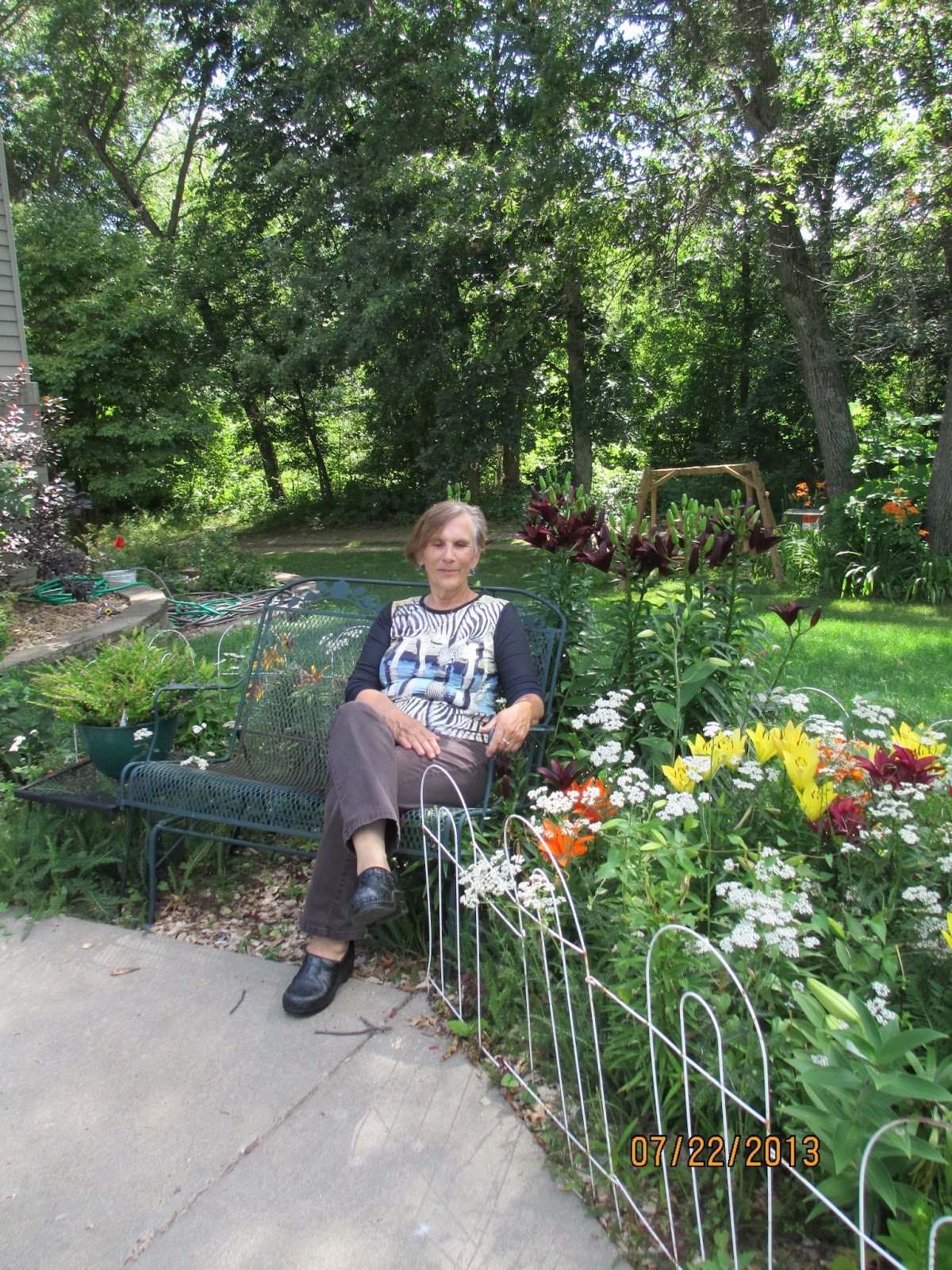
THE GARDENER ENJOYING HER ASIAN LILIES, YARROW AND OTHER FLOWER GARDENS...NECTAR FOR THE BEES AND BUTTERFLIES
The gardener herself!
 Besides the vegetable gardens, Maggie has an array of flower gardens. Just because she enjoys the beauty of flowers and also to support the bees and butterflies to assist in pollination of her vegetables. Enjoy.!


Thursday, July 18, 2013
ON-SITE GARDENING CONSULTATIONS
I have met so many people that say "I would love to start my own vegetable gardens in my backyard but I just don't know where to start. I get so confused by all the literature that is out there and I just don't have time to figure it all out." Well, to all of you who feel this way, please know that help is available. Help that can introduce you to the "process" of gardening in simple, scientific and fun ways and you can have that vibrant, healthy backyard vegetable/herb garden. And for those of you that have your gardens but just need a little help to make your gardens better, we are there for you also. We also provide services for any business that deciding to help their employees and themselves develop healthier choices in food and believe a garden on site would help meet that goal.
We provide a unique service in that we come to you and your potential or present garden site and help you assess what you want in a vegetable garden. The following are some of the services we provide on a consultation and with educational materials:
We provide a unique service in that we come to you and your potential or present garden site and help you assess what you want in a vegetable garden. The following are some of the services we provide on a consultation and with educational materials:
- Consultation visit at the site of the potential garden(s) or present gardening site for individuals, families and businesses
- Evaluation of soil and soil amendment/nutritional needs. Soil preparation for planting of vegetables/herb. Soil testing if necessary Recommendations for resources, such as where to get containers, raised garden beds, straw for straw bale gardening, soil and compost, educational resource information related to the garden project
- Assessment of sunlight and on-going water needs along with best watering approaches
- Assistance in choosing plant and seeds for garden if requested; fertilization needs throughout the growing season
- And more based on your individual needs and requests
- Documentation by consultant in writing (by email and/or mail) of recommendations and outcome of the consultation
We work with container gardening, soil gardening, vertical gardening, straw bale gardening, raised garden bed gardening and any combinations. Gardening is a process from seed and plant selection to harvesting, garden cleanup and enjoying the produce of your successful gardening. Once you have some success you will continue to make time and room in your life for this healthy alternative to processed foods.
Invite your children to participate in both the consultation and creation of your gardens. When you can start educating your children when they are very young, then they will make better and healthier choices about what food means and what kind of food they want in their lives. My bet would be that they would choose the healthy, vibrant, tasteful home grown vegetables and herbs that you introduced them to when they were young. Thanks mom and dad!!
We have a strong commitment to help individuals become more empowered in their food choices and become even more educated in the nutritional values of food grown organically. As a result we offer another unique service... we provide here on our blog nutritional values for each vegetable. Not just the usual listings of protein, fat, minerals, vitamins, etc. but how to incorporate these very nutritious foods into your diet and how they affect and assist in good health for your body in everyday life. Presented in ways that make sense to everyone.
GARDEN UPDATES...WHAT IS GROWING WELL AND WHAT IS NOT GROWING QUITE SO WELL
As it is about half way through the growing season, it is time to evaluate how everything is growing. What is working and what is not working as well as expected. What problems were encountered and possible reasons why and possible solutions to the problem, etc.
I planted fava beans for the first time....a dried large bean good in soups, stir fries and other hot dishes. I had no idea what to expect. They have large bean pods growing on them almost showing up over night! A great success!


The last few years I have planted the zucchini in my garden soil, however the squash vine bore killed my plants before I could harvest the full capacity of the plants. This year I tried planting two zucchini in container plants and they have done poorly. The zucchini has long, deep roots and needs a very large container with big drain holes on the bottom and my containers may not have been big enough. I believe the roots were compressed not allowing for good growth. I then planted six zucchini plants in my garden soil. What the heck I said. Lets see what happens with the squash vine bore. So far the zucchini in the soil looks great without the squash vine bore showing up. We'll see. I will watch closely.


I planted fava beans for the first time....a dried large bean good in soups, stir fries and other hot dishes. I had no idea what to expect. They have large bean pods growing on them almost showing up over night! A great success!


I grew cabbage in containers again this year along with some in the soil. The containers have been used for the 3rd year because the gophers have eaten the roots and I have lost a lot of cabbage in the process. Last year the cabbage were big and beautiful. I used 1/2 compost and 1/2 garden soil along with side dressing them with compost every two to three weeks.
This year the cabbage in most all the containers are small with brownish to lightly purplish lower levels (a sign of phosphorus deficiency. The cabbage planted in the raised beds look great, vital, large and no gopher damage this year. There was so much rain that I do believe that the nutrition added to the containers was quickly washed away and that the cabbage in containers needed lots more composting or a good 20-20-20 fertilizer every 2 weeks or after rain. I also used potting soil in the cabbage containers this year and do question if it would be better to have 1/3 potting soil/1/3 garden soil/1/3 compost for containers next year. The raised beds where the cabbage was grown in soil had compost from my garden compost pile added to the top of the soil, about one inch in depth with the straw that was left on the top of the raised beds from last year tilled in, making for a great organic soil.


The last few years I have planted the zucchini in my garden soil, however the squash vine bore killed my plants before I could harvest the full capacity of the plants. This year I tried planting two zucchini in container plants and they have done poorly. The zucchini has long, deep roots and needs a very large container with big drain holes on the bottom and my containers may not have been big enough. I believe the roots were compressed not allowing for good growth. I then planted six zucchini plants in my garden soil. What the heck I said. Lets see what happens with the squash vine bore. So far the zucchini in the soil looks great without the squash vine bore showing up. We'll see. I will watch closely.


Stay tuned for more garden evaluations. Enough for today. To be continued...............................
Subscribe to:
Posts (Atom)